Me: Looks at calendar. Then (faintly): "Drat! Drat, drat, drat...."
Sounds of frantic typing.
Coming June 1st to this blog: the desperate search for an (accurate) description of hanafuda.
Tuesday, May 31, 2016

Monday, February 29, 2016
Sakura-yu
What is sakura-yu/sakurayu, or cherry (blossom) hot water? I'm glad you asked, cuz otherwise I'd be wondering how you got here.... (by the way, how did you get here?)
Sakura-yu is this: take half-open, double layered cherry blossoms with their stems, preserve them with ume vinegar and salt. Place one or two in a cup and pour in some boiling water. Then drink it. You can eat the flowers too, though I don't know if it's uncouth to do so.
(In the interest of total honesty, there's some other definitions -- at least one book that says sakura-yu is made with cherry leaves, and two definitions make it sound like you salt the water separately. At least one refers to the blossoms as having been pickled). But most people say that the drink uses salted cherry blossoms, so for now the majority wins.)
I've seen pictures and it can look very pretty -- imagine a pink flower (some pictures show paler pinks than others) as it floats underwater.

See, I told you it was pretty.
Sakura-yu is supposed to be a smidge in the pink direction (which I didn't realize when I made that picture), and since I don't know how to make blue-pink in MS Paint yet, you'll just have to imagine the water's tinted.
What's it taste like? I've seen it described as slightly sweet in at least one book, but I've found three places that say it's salty (and one place says its a bit salty and sour). A recurring word is "refreshing". Probably depends on the how the flower was preserved, as well as the person -- the person's taste, I mean. Probably.
Here's a video that has some captions but doesn't have a lot of actual spoken dialogue. In it, a man makes sakura-yu from scratch. It's kinda funny, and you get to see some nice views of nature and such.
Like various foods and drinks around the world, people have attached symbolism to sakura-yu. You drink it for occasions like weddings, o-miai (a meeting between two people who might want to marry) and betrothals (how common is this in Japan?) One place says it's drunk instead of tea at weddings -- as the book was on Shinto, the author was talking about Shinto weddings, I guess. Suppose I could have poked around to get at the context, but I didn't!
People also drink sakura-yu during springtime as a way of saying "hey, it's spring!" Like here with ice cream, lemonade and barbecue in summer and pumpkin or apple pie-flavored everything starting in fall. To which peppermint-flavored everything is added in winter. (Hey, do we even have any foods for spring? Hmm, I'd never thought about that before...macaroni salad, perhaps.)
Why is it drunk at these times? More than once I've read it's because the cherry's got some auspicious symbolism. It's clearer than tea, which in the context of a wedding transmutes into the couple having a clear (not cloudy) marriage.
It also would be bad to serve tea at a wedding because the tea would make the wedding a joke (it's symbolism does this). I really have no idea with that one.
For some East meets West human interest, and to show you how long sakura-yu has been a commercial product, lemme show you this travelogue written by one Benjamin Robbins Curtis:
"We sit down at one of the many little tables covered with awnings, which are scattered over the summit of the hill, and are served with a most refreshing drink -- a fragrant sort of tea made from cherry-blossoms, called sakura-yu. Our waitress...serves the tea in little cups, wishes us all a polite good morning, and then retires to superintend the manufacture of more sakura-yu."
That, along with the rest of the book, was published in 1876. S'right, that was nearly 140 years ago. It was the reign of emperor Meiji, and princess Kazunomiya would still be alive until the next year.
Other than making it at home (Amazon sells salted cherry blossoms, if you're wondering), you can also get it at certain food establishments -- don't ask me what kind, I haven't found out in particular yet. All I know for sure is that its supposed to be offered as part of eating kuriimu anmitsu at a place in Tokyo named Takemura.
References:
Coming soon!
Sakura-yu is this: take half-open, double layered cherry blossoms with their stems, preserve them with ume vinegar and salt. Place one or two in a cup and pour in some boiling water. Then drink it. You can eat the flowers too, though I don't know if it's uncouth to do so.
 |
| One way to spell sakura-yu. Google Translate calls this "infusion of salted cherry blossoms". |
(In the interest of total honesty, there's some other definitions -- at least one book that says sakura-yu is made with cherry leaves, and two definitions make it sound like you salt the water separately. At least one refers to the blossoms as having been pickled). But most people say that the drink uses salted cherry blossoms, so for now the majority wins.)
I've seen pictures and it can look very pretty -- imagine a pink flower (some pictures show paler pinks than others) as it floats underwater.
See, I told you it was pretty.
Sakura-yu is supposed to be a smidge in the pink direction (which I didn't realize when I made that picture), and since I don't know how to make blue-pink in MS Paint yet, you'll just have to imagine the water's tinted.
What's it taste like? I've seen it described as slightly sweet in at least one book, but I've found three places that say it's salty (and one place says its a bit salty and sour). A recurring word is "refreshing". Probably depends on the how the flower was preserved, as well as the person -- the person's taste, I mean. Probably.
Here's a video that has some captions but doesn't have a lot of actual spoken dialogue. In it, a man makes sakura-yu from scratch. It's kinda funny, and you get to see some nice views of nature and such.
Like various foods and drinks around the world, people have attached symbolism to sakura-yu. You drink it for occasions like weddings, o-miai (a meeting between two people who might want to marry) and betrothals (how common is this in Japan?) One place says it's drunk instead of tea at weddings -- as the book was on Shinto, the author was talking about Shinto weddings, I guess. Suppose I could have poked around to get at the context, but I didn't!
People also drink sakura-yu during springtime as a way of saying "hey, it's spring!" Like here with ice cream, lemonade and barbecue in summer and pumpkin or apple pie-flavored everything starting in fall. To which peppermint-flavored everything is added in winter. (Hey, do we even have any foods for spring? Hmm, I'd never thought about that before...macaroni salad, perhaps.)
Why is it drunk at these times? More than once I've read it's because the cherry's got some auspicious symbolism. It's clearer than tea, which in the context of a wedding transmutes into the couple having a clear (not cloudy) marriage.
It also would be bad to serve tea at a wedding because the tea would make the wedding a joke (it's symbolism does this). I really have no idea with that one.
For some East meets West human interest, and to show you how long sakura-yu has been a commercial product, lemme show you this travelogue written by one Benjamin Robbins Curtis:
"We sit down at one of the many little tables covered with awnings, which are scattered over the summit of the hill, and are served with a most refreshing drink -- a fragrant sort of tea made from cherry-blossoms, called sakura-yu. Our waitress...serves the tea in little cups, wishes us all a polite good morning, and then retires to superintend the manufacture of more sakura-yu."
That, along with the rest of the book, was published in 1876. S'right, that was nearly 140 years ago. It was the reign of emperor Meiji, and princess Kazunomiya would still be alive until the next year.
Other than making it at home (Amazon sells salted cherry blossoms, if you're wondering), you can also get it at certain food establishments -- don't ask me what kind, I haven't found out in particular yet. All I know for sure is that its supposed to be offered as part of eating kuriimu anmitsu at a place in Tokyo named Takemura.
References:
Coming soon!
Saturday, January 16, 2016
Ochazuke
Rice and green tea as a soup. If you're used to thinking of green tea as just a drink, or even as a dessert ingredient, that combination may sound gross. But it is a real thing. You may have even read about it already, like in
Cynthia Kadohata's Kira-Kira (which I didn't finish, myself) -- or if you read this blog, you may have come across it in this post. It's called ochazuke (お茶漬け).
Table of Contents:
Short, Short Histories
Ingredients
Types
How To Serve (And Eat) It
Alternate Routes to Ochazuke
Cultural Facts
References
Short, Short Histories
 Though it might seem like it,
ochazuke is not an invention of dorm cooking (so far as I know). Nor was it the invention
of a medieval-ish wizard trapped in an alternate form of Australia (those who have read The Last Continent know what I'm talking about).
Though it might seem like it,
ochazuke is not an invention of dorm cooking (so far as I know). Nor was it the invention
of a medieval-ish wizard trapped in an alternate form of Australia (those who have read The Last Continent know what I'm talking about).
The origin, as one explanation goes, began with the common person. That is, ochazuke was just something people did at home (like tomato or mustard sandwiches, I guess). They'd put the two ingredients together and add a little nori on top. From there, it just grew in psychological weight until it was considered a dish in its own right. But that's not the only explanation out there...
Another origin story says that the dish was something that developed out of busy employees needing to eat while at work. The Genroku period (1688 to 1704) being the place in time where the ochazuke vendor began.
(And, on a related note, there's a story that the legendary Basho (1644 to 1694), who obviously lived a good chunk of his life in the Genroku period, liked ochazuke.)
Ingredients
Though
you can find all sorts of recipes for it, the two pillar ingredients of ochazuke, the only two things you really need for it, are rice and steeped green
tea. At least, that's what most of my sources say or seem to indicate.
What do people generally add to it? Weeeellll, let's have a rhetorical question first: what do you put in a sandwich? S'right. All you can really pin it down to is "food", and if you want to be a purist, "savory food", save for pb&j sandwiches and the random dessert sandwich.
To actually relate what I have read to you, the interested reader/internet surfer (or whoever you may be), there are a number of books that say people only add one other ingredient -- and yes, they tend to disagree on what that ingredient is. Two books said to put some of nori on top, and a third said to use some fish. A fourth book seemed to say that hamanatto -- cooked, fermented, soaked and dried soybeans -- is part of a complete ochazuke.
But, some places have said, it's pretty much whatever, which seems to be true enough, considering the above paragraph. Examples of
additional ochazuke ingredients include rice crackers, wakame,
umeboshi, nori (again), shiokonbu (salted kelp, shredded),
grated ginger, tempura, instant dashi, miso, spinach, sesame seeds,
tsukemono (actually placed in the soup), wasabi paste, and fish in various forms of preparation (from salmon flakes to
cooked or raw pieces of fish), fish roe... Or any combination of the above
thereof. So yeah, basically whatever you think would go with the rice
and tea.
But to further loosen the sense of a definitive definition of ochazuke, let's semi-backtrack to the liquid aspect of it. Looks like any kind of steeped green tea will do, both bancha and sencha are common, but I found several books that say you don't even have to use green tea. The replacement? Fish stock. And one book said the traditional tea for ochazuke is matcha, which doesn't seem like it would've been the food of the common man.
Types
And while we're focusing on ingredients, there are different names for certain types of ochazuke. (I assume they were named after the ingredient(s) added into it). To give examples, there's nori chazuke, tai chazuke (tai is sea bream here) and tsukemono chazuke. Considering the propensity of humanity for naming things and getting creative with food, I wanna say that there are probably other types out there, I just haven't come across them yet.
Though the details yet elude me, know that there are kinds of ochazuke out there connected to different parts of Japan. Thus I, the self-styled authority, have spoken!
How To Serve (And Eat) It
It's acceptable to eat your ochazuke hot or cold. The thing is to have it cold in summer and hot in winter, just like soba. As for the ratio, it's about what you'd do for boxed cereal and milk (or milk substitute, if that's what'cha do). To consume your ochazuke, eat the solids then drink the liquid. (Dunno 'bout you, but I'd probably end up bobbing for rice with my chopsticks, if I didn't drink down the tea/broth once in a while). A definite side dish, or so it looks to me, is tsukemono (漬物) -- though one book said Western pickles work too.
If you want a dash of extra officialness to round out your knowledge of ochazuke etiquette, behold this paragraph! For there came unto my attention an
old (1955) etiquette book produced by the YWCA! It was a little hard for me
to understand, but I think you're supposed to eat the pickles with the
ochazuke, and after they are gone (I assume you're supposed to finish
them first?), eat the rest of the ingredients. Unless it was
talking about meat being served with the ochazuke... sigh... Anyway, other than the above, the book's rules state that if you feel like shoveling the rice from the bowl into your mouth, go right ahead and do that -- it's okay because that's how you're supposed to do it with ochazuke or rice with water on it.
Now, onto when to eat it. Again, differing sources. While I've seen an emphasis on it being something for later in the day (aka not breakfast), it depends on who you talk to. People describe it as a snack or light meal, and it can be served at the end/near the end of a meal -- even a fancy one, if you use fancy ingredients.
So why not eat it whenever you want! Especially after a meal of fatty foods, with pickled cucumber -- that's a tradition, or so I'm told.
Alternate Routes To Ochazuke
For
those too tired (or lazy disinclined) to make even basic ochazuke proper, there is a
solution! Well, two actually. The first is, of course, to go and find a
place that serves ochazuke. Yes, the 300 year old tradition is still going strong -- ochazuke-ya compete with shokudo (a cafeteria type place) and other restaurants. A
tonkatsu restaurant, Suzuya (in Shinjuku ward) serves their tonkatsu with ochazuke: that is, the tonkatsu is put on
rice, and you, the diner, pour tea over top it all.
The second alternative, which does involve some personal work, is to get yourself some instant ochazuke -- possibly called ochazuke no moto (though I saw one place say furikake) -- as produced by companies like Nagatani-En (famous for its instant ochazuke). This means you buy a packet specifically designated as ochazuke flavoring, put the packet's contents on some rice (previously cooked and placed in a bowl), and add hot water or tea (sources vary). However, these packets, while they come in different flavors like wasabi and salmon, tend to be supremely unhealthy.
Cultural Facts
First up, the common perception of ochazuke in Japan today. Descriptive words you might see should you start your own ochazuke research adventures include homey, country and comfort food. "Just Between Me and You Volume IV" likened ochazuke to chicken soup. It's seen as something that cures colds as well as hangovers.
Zooming in on Kyoto -- where the word for ochazuke is bubuzuke --, I've found several traditions concerning ochazuke. One tradition was/is this: the dish is offered to guests at the meal's end, not so much as a course as a message: go home. I've read that today, in Kyoto if someone wants his or her guest to leave, he or she asks if the guest wants ochazuke, and the guest is supposed to take the hint and make his or her goodbyes. Another tradition in Kyoto is to eat ochazuke for breakfast.
Over on this side of the Pacific it's supposed to be popular among Japanese-American families.
References
Table of Contents:
Short, Short Histories
Ingredients
Types
How To Serve (And Eat) It
Alternate Routes to Ochazuke
Cultural Facts
References
Short, Short Histories
Though it might seem like it,
ochazuke is not an invention of dorm cooking (so far as I know). Nor was it the invention
of a medieval-ish wizard trapped in an alternate form of Australia (those who have read The Last Continent know what I'm talking about).The origin, as one explanation goes, began with the common person. That is, ochazuke was just something people did at home (like tomato or mustard sandwiches, I guess). They'd put the two ingredients together and add a little nori on top. From there, it just grew in psychological weight until it was considered a dish in its own right. But that's not the only explanation out there...
Another origin story says that the dish was something that developed out of busy employees needing to eat while at work. The Genroku period (1688 to 1704) being the place in time where the ochazuke vendor began.
(And, on a related note, there's a story that the legendary Basho (1644 to 1694), who obviously lived a good chunk of his life in the Genroku period, liked ochazuke.)
Ingredients
What do people generally add to it? Weeeellll, let's have a rhetorical question first: what do you put in a sandwich? S'right. All you can really pin it down to is "food", and if you want to be a purist, "savory food", save for pb&j sandwiches and the random dessert sandwich.
To actually relate what I have read to you, the interested reader/internet surfer (or whoever you may be), there are a number of books that say people only add one other ingredient -- and yes, they tend to disagree on what that ingredient is. Two books said to put some of nori on top, and a third said to use some fish. A fourth book seemed to say that hamanatto -- cooked, fermented, soaked and dried soybeans -- is part of a complete ochazuke.
 |
| Garden fresh is always best. Except for, y'know... cheese and stuff. |
But to further loosen the sense of a definitive definition of ochazuke, let's semi-backtrack to the liquid aspect of it. Looks like any kind of steeped green tea will do, both bancha and sencha are common, but I found several books that say you don't even have to use green tea. The replacement? Fish stock. And one book said the traditional tea for ochazuke is matcha, which doesn't seem like it would've been the food of the common man.
Types
And while we're focusing on ingredients, there are different names for certain types of ochazuke. (I assume they were named after the ingredient(s) added into it). To give examples, there's nori chazuke, tai chazuke (tai is sea bream here) and tsukemono chazuke. Considering the propensity of humanity for naming things and getting creative with food, I wanna say that there are probably other types out there, I just haven't come across them yet.
Though the details yet elude me, know that there are kinds of ochazuke out there connected to different parts of Japan. Thus I, the self-styled authority, have spoken!
How To Serve (And Eat) It
It's acceptable to eat your ochazuke hot or cold. The thing is to have it cold in summer and hot in winter, just like soba. As for the ratio, it's about what you'd do for boxed cereal and milk (or milk substitute, if that's what'cha do). To consume your ochazuke, eat the solids then drink the liquid. (Dunno 'bout you, but I'd probably end up bobbing for rice with my chopsticks, if I didn't drink down the tea/broth once in a while). A definite side dish, or so it looks to me, is tsukemono (漬物) -- though one book said Western pickles work too.
 |
| Isn't this a chopstick no-no? |
Now, onto when to eat it. Again, differing sources. While I've seen an emphasis on it being something for later in the day (aka not breakfast), it depends on who you talk to. People describe it as a snack or light meal, and it can be served at the end/near the end of a meal -- even a fancy one, if you use fancy ingredients.
So why not eat it whenever you want! Especially after a meal of fatty foods, with pickled cucumber -- that's a tradition, or so I'm told.
Alternate Routes To Ochazuke
 |
| Two roads diverge in Mauchline, in Scotland. |
The second alternative, which does involve some personal work, is to get yourself some instant ochazuke -- possibly called ochazuke no moto (though I saw one place say furikake) -- as produced by companies like Nagatani-En (famous for its instant ochazuke). This means you buy a packet specifically designated as ochazuke flavoring, put the packet's contents on some rice (previously cooked and placed in a bowl), and add hot water or tea (sources vary). However, these packets, while they come in different flavors like wasabi and salmon, tend to be supremely unhealthy.
Cultural Facts
First up, the common perception of ochazuke in Japan today. Descriptive words you might see should you start your own ochazuke research adventures include homey, country and comfort food. "Just Between Me and You Volume IV" likened ochazuke to chicken soup. It's seen as something that cures colds as well as hangovers.
Zooming in on Kyoto -- where the word for ochazuke is bubuzuke --, I've found several traditions concerning ochazuke. One tradition was/is this: the dish is offered to guests at the meal's end, not so much as a course as a message: go home. I've read that today, in Kyoto if someone wants his or her guest to leave, he or she asks if the guest wants ochazuke, and the guest is supposed to take the hint and make his or her goodbyes. Another tradition in Kyoto is to eat ochazuke for breakfast.
Over on this side of the Pacific it's supposed to be popular among Japanese-American families.
References
For food researcher-ists and other interested parties:
"Seductions of Rice"; Jeffrey Alford, Naomi Duguid; 2003 (sorry about this one, but I did use the information, I think).
"The Kinfolk Table: Recipes for Small Gatherings"; Nathan Williams; 2013
"The Essence of Japanese Cuisine: An Essay on Food and Culture"; Michael Ashkenazi, Jeanne Jacob; 2000
"The Essence of Japanese Cuisine: An Essay on Food and Culture"; Michael Ashkenazi, Jeanne Jacob; 2000
"Dining
Guide to Japan: Find the right restaurant, order the right dish, and
pay the right price!"; Front Cover Boye Lafayette De Mente; 2011
Gurunavi: Japan Restaurant Guide: Ochazuke
"Origin"; Cid Corman; 1963
"Wisdom of the Last Farmer: Harvesting Legacies from the Land"; David Mas Masumoto; 2009
"Asian Pickles: Japan: Recipes for Japanese Sweet, Sour, Salty, Cured, and Fermented Tsukemono"; Karen Solomon; 2012
Gurunavi: Japan Restaurant Guide: Ochazuke
"Origin"; Cid Corman; 1963
"Wisdom of the Last Farmer: Harvesting Legacies from the Land"; David Mas Masumoto; 2009
"Asian Pickles: Japan: Recipes for Japanese Sweet, Sour, Salty, Cured, and Fermented Tsukemono"; Karen Solomon; 2012
You made it! By the way, if you're a dedicated fact-verifier and you spot something, make sure to send me a comment so I can make the post even better.
Thursday, December 31, 2015
The Teradaya Incident
Or how, during the second year of the Keiō era, a woman named Narasaki Ryō saved the samurai Sakamoto Ryōma (or 坂本龍馬).
Well, that's part of it.
Let's set the scene. The date is March 9, 1866. We're south of Kyoto, in a place called Fushimi, and we're at an inn, the Teradaya (寺田屋). A samurai (and diplomat) from Tosa domain, named Sakamoto Ryōma (he's quite famous, actually) has a room there. This is not something out out of the ordinary, 'cause he has checked in here other times, and is on friendly terms with the inn's landlady, Otose -- a very nice lady, who also liked to help reformers, which Sakamoto is one. (In fact, at this point, Sakamoto has very recently worked to create an alliance between the Satsuma and Chōshū clans).
At this moment, he's in his room (the ume no ma which translates as the plum room -- is this sounding like Clue yet?) with his bodyguard or friend (depends on the book) Miyoshi Shinzō from Chōshū. The room's on the second floor, and the two have basically gotten all ready to just go to sleep. Sakamoto can hear people on the move, trying to be quiet below when....
We now switch to a maid at the inn, who's currently having a soak in the bath. Her name is Narasaki Ryō, though also known popularly as Oryō . She either is Sakamoto's wife, or sort of girlfriend and/or someone who at some later time becomes his wife. (One place said she got her job at the inn because of being Sakamoto's girlfriend).
It is while she's in the bath that Oryō somehow realizes that Bakufu officers from the Fushimi magistrate were at the inn for a raid/attack. (The magistrate knew that there were anti-Bakufu people at the inn via the grapevine or spies or something like that).
So Oryō foreshortens her bath, goes up the backstairs to Sakamoto and company, telling him about the raid/attack that's in progress. Sakamoto and Miyoshi arm themselves -- the former with a six-shooter by Smith & Wesson (bought in Shanghai by one Takasugi Shinsaku) and the latter with a spear (he also had two swords).
At some point, the fight breaks out (and yes, that's as much detail as I can give you there). During the raid/skirmish/fight Sakamoto's hands get a bit cut up, but he and Miyoshi are able to make a tactical retreat (it was good enough for George Washington, so I don't see why anyone else should have a problem with it). They take shelter in the Satsuma clan's mansion/residence/station that's in/near Fushimi. The End.
Of the incident anyway. As a little addendum-type thing, the Teradaya Inn burned down two years after the attempt on Sakamoto's life. They rebuilt it though, and it kinda memorializes the incident, with a picture each of Ryōma (who also has a statue out front) and Otose in the entrance. Now, the inn's address is located at 263 Minamihama-cho Fushimi, Kyoto.
That same year in the fall, Sakamoto gave an account of the incident to his brother, in writing. If you want to take a look at a translation of Sakamoto's recollection, that is if you want more specific details of the fight, then see the last reference in the reference section below.
(Oh, and if you're wondering why this isn't about the 1862 incident, you are an adept at history. I call this incident the Teradaya Incident because other people have. I know, shameless following! But what can ya do? They're already published.)
References:
Because you don't just have to take my word for it. Take some other peoples' too! ;)
"Cool Japan: A Guide to Tokyo, Kyoto, Tohoku and Japanese Culture Past and Present"; Sumiko Kajiyama; 2013
"Seeing Kyoto"; Juliet Winters Carpenter; 2005
"The Satsuma Students in Britain: Japan's Early Search for the "Essence of the West'"; Andrew Cobbing; 2013
"Samurai Revolution: The Dawn of Modern Japan Seen Through the Eyes of the Shogun's Last Samurai"; Romulus Hillsborough; 2014
"Sakamoto Ryōma and the Meiji Restoration"; Marius B. Jansen; 1994
Well, that's part of it.
Let's set the scene. The date is March 9, 1866. We're south of Kyoto, in a place called Fushimi, and we're at an inn, the Teradaya (寺田屋). A samurai (and diplomat) from Tosa domain, named Sakamoto Ryōma (he's quite famous, actually) has a room there. This is not something out out of the ordinary, 'cause he has checked in here other times, and is on friendly terms with the inn's landlady, Otose -- a very nice lady, who also liked to help reformers, which Sakamoto is one. (In fact, at this point, Sakamoto has very recently worked to create an alliance between the Satsuma and Chōshū clans).
At this moment, he's in his room (the ume no ma which translates as the plum room -- is this sounding like Clue yet?) with his bodyguard or friend (depends on the book) Miyoshi Shinzō from Chōshū. The room's on the second floor, and the two have basically gotten all ready to just go to sleep. Sakamoto can hear people on the move, trying to be quiet below when....
We now switch to a maid at the inn, who's currently having a soak in the bath. Her name is Narasaki Ryō, though also known popularly as Oryō . She either is Sakamoto's wife, or sort of girlfriend and/or someone who at some later time becomes his wife. (One place said she got her job at the inn because of being Sakamoto's girlfriend).
It is while she's in the bath that Oryō somehow realizes that Bakufu officers from the Fushimi magistrate were at the inn for a raid/attack. (The magistrate knew that there were anti-Bakufu people at the inn via the grapevine or spies or something like that).
So Oryō foreshortens her bath, goes up the backstairs to Sakamoto and company, telling him about the raid/attack that's in progress. Sakamoto and Miyoshi arm themselves -- the former with a six-shooter by Smith & Wesson (bought in Shanghai by one Takasugi Shinsaku) and the latter with a spear (he also had two swords).
At some point, the fight breaks out (and yes, that's as much detail as I can give you there). During the raid/skirmish/fight Sakamoto's hands get a bit cut up, but he and Miyoshi are able to make a tactical retreat (it was good enough for George Washington, so I don't see why anyone else should have a problem with it). They take shelter in the Satsuma clan's mansion/residence/station that's in/near Fushimi. The End.
Of the incident anyway. As a little addendum-type thing, the Teradaya Inn burned down two years after the attempt on Sakamoto's life. They rebuilt it though, and it kinda memorializes the incident, with a picture each of Ryōma (who also has a statue out front) and Otose in the entrance. Now, the inn's address is located at 263 Minamihama-cho Fushimi, Kyoto.
That same year in the fall, Sakamoto gave an account of the incident to his brother, in writing. If you want to take a look at a translation of Sakamoto's recollection, that is if you want more specific details of the fight, then see the last reference in the reference section below.
(Oh, and if you're wondering why this isn't about the 1862 incident, you are an adept at history. I call this incident the Teradaya Incident because other people have. I know, shameless following! But what can ya do? They're already published.)
References:
Because you don't just have to take my word for it. Take some other peoples' too! ;)
"Cool Japan: A Guide to Tokyo, Kyoto, Tohoku and Japanese Culture Past and Present"; Sumiko Kajiyama; 2013
"Seeing Kyoto"; Juliet Winters Carpenter; 2005
"The Satsuma Students in Britain: Japan's Early Search for the "Essence of the West'"; Andrew Cobbing; 2013
"Samurai Revolution: The Dawn of Modern Japan Seen Through the Eyes of the Shogun's Last Samurai"; Romulus Hillsborough; 2014
"Sakamoto Ryōma and the Meiji Restoration"; Marius B. Jansen; 1994
Monday, November 2, 2015
Ochazuke no Aji
 |
| "Ochazuke no aji" |
Though also the title of a literary work by Mori Minoru, the subject of today's post, Ochazuke no aji, is an old movie, known in English as Flavor of Green Tea over Rice. (There are other translations, but that's the one IMBD uses). The first draft being censored, a rework of it was released in 1952. The plot? A marriage in crisis, plus a sub-plot concerning the couple's niece.
Quick History
It goes like this. In 1939, the director, Ozu Yasujirō, wrote a draft for a movie -- unless it was him and a man named Ikeda -- after he came back from Japan's front in China. (He'd had to be in the army as an infantry corporal since July 1937, on account of the Sino-Japanese War). The censors (there was a lot of censorship between 1931 and 1945) objected to it for it's lack of patriotism.
After all, the Motion Picture Law had been passed that year, which meant more censorship than before. Ozu received a "no go" for it in the February of 1940 -- unless it was sometime in 1938. Later a second draft was created either by Ozu and Kōgo Noda or by Noda... or something. At any rate, Ozu was the director, and in 1952 it was filmed and released in Japan that October, on the 1st. The U.S. release happened in 1964.
Now for the plots.
The 1939 Plot
Be ready, this gets kinda scary (you'll see what I mean). So... there's this couple, their marriage was an arranged marriage. He's a simple things kinda guy, and a dedicated business man, while she's the opposite, up to date on fashion and also selfish. Her husband's existence causes in her soul the bored feeling.
Things get dramatic. The husband gets the draft notice, and is fatalistic about it, while the wife feels distinctly unhappy about it. The night before he's sent out, they have dinner together, where they have (you guessed it), ochazuke. But that's not quite the end of it: during this meal, the wife, who finds her husband's fatalism irritating, asks if he doesn't want to die. He tells her that he thinks life is a gamble no matter where you are and that he does his best for where he works -- so I guess he has no regrets and does his best, kinda thing? Well, anyway, she starts to cry. What is this husband's response his wife's tears? He slaps her and calls her selfish. (Just wait, it gets scarier). The wife's response to that? She has an epiphany of happiness, and feels herself really loving him.
(Told ya.)
Now, just to clear up any confusion, apparently, the slap was to make her think of being a proper Japanese citizen, not a the slap of "I'm a man, so I don't have to be a decent human being, especially to my wife". Like that makes it any better.
But wait, there's an icky little cherry to go on top scary mess of a story: the last scene has the wife telling her friends about the dinner of violence -- and they say, Yep, that's what men are like!
Feel free to start breathing into a paper bag, if you need to.
So, why on earth was this uncomfortable piece of work not allowed? Officially, the censors said it was because the "couple" ate the wrong thing at the "last dinner together" scene -- though I saw one place say that this only a tradition concerning the movie, not an actual official reason. The censors said that the meal should have been sekihan (red beans and rice), a dish served at celebrations, and the dish that custom dictated was to be served as part of sending off a drafted person. So it wasn't patriotic enough. And it wasn't just that.
Oh no, the draft contained other shameful things such as not being serious enough. And it mentioned customs and words that were from (gasp!) the Occident. These other two things, you see, were breaking the law, the 1937-1938 Home Ministry Code to be precise.
The 1952 Plot
First, here's the movie's cast:
Shin Saburi as Mokichi Satake
Michiyo Kogure as Taeko Satake (Mokichi's wife)
Koji Tsuruta as Noboru
Chishu Ryu as Sadao Hirayama
Chikage Awajima as Aya Amamiya
Keiki Tsujima as Setsuko
And now, a brief (possibly incomplete) summary:
It goes like this (some parts may sound familiar by now). There's this well-off couple , right? (They have servants). They have no kids, and the both of them are in their middle years.
The husband, Mokichi, is an engineering company's executive, and is a nice man with simple tastes and of few words, who is also "uncultured" while at table. The wife, Taeko -- a selfish social climber -- finds herself bored with Mokichi, who she calls Dull-chan. Taeko, in her disdain towards Mokichi, even has a habit of lying to him, including lying about going to a spa with her friends and Setsuko, Mokichi's niece.
Watching aunty and her friends talk about their husbands, Setsuko decides that she doesn't want to go into an arranged marriage. Something that her mother has been working on. At some point Aunty Taeko is pressured (by Mokichi's family) to have Setsuko go into an arranged marriage, but Setsuko doesn't bow down -- she tells aunty that arranged marriages are medieval in a bad way, and uses aunty's dead marriage as an example. Setsuko even escapes from an o-miai, a meeting between two prospective marriage partners.
After the o-miai, Setsuko goes around with uncle Mokichi and a man with an office job, Noboru. It is with Noboru that (at some point, dunno when exactly) she visits the city, including a pachinko parlor with a regretful owner and a ramen shop, where they eat -- Noboru also has "low-class" tastes. (Random note: this movie is the first from Japan to use the word rāmen in its script).
When Taeko finds out Mokichi (who, it turns out, always could tell when Taeko was lying) is/was being complicit with Setsuko's unfilial desire to pick her own husband, she picks an argument with him. And then decides she wants to be by herself for a while.
This is, of course, when Mokichi receives the draft, to be immediately put in Uruguay so of course he can't tell her in person what's happening because she's gone off to be alone. But! The plane he gets on has to head back. Taeko is waiting for him at the house, and has spent time thinking. Together they figure out the kitchen and make ochazuke (Mokichi's habit of eating had been annoying to Taeko), each of them having said how much they do care about the other. Taeko realizes that her unassuming pleb of a husband has it right after all when it comes to living. Their marriage is saved.
Ochazuke no aji lasts for a total of either 115 or 116 minutes. Watch out for a Jean Marais shout-out (I've actually seen him a few times in a 1946 rendition of Beauty and the Beast), and for a restaurant called Calorie --- if you happen to see Tokyo Chorus, it's in there too.
References:
Helping us with our homework every time there's a paper! The places I used:
"Historical Dictionary of Postwar Japan"; William D. Hoover; 2011
"The Imperial Screen: Japanese Film Culture in the Fifteen Years' War, 1931-1945"; Peter B. High; 2003
National Library of Australia: 1952, English, Japanese, Video, Captioned edition: Flavour of green tea over rice [motion picture] = Ochazuke no aji.
Center of Japanese Studies Publications: "Ozu and the poetics of cinema"; David Bordwell; 1988
"The Untold History of Ramen: How Political Crisis in Japan Spawned a Global Food Craze"; George Solt; 2014
"Transcendental Style in Film: Ozu, Bresson, Dreyer"; Paul Schrader; 1972
"Ozu"; Donald Richie; 1974
"Eigagaku No Susume"; Mark Howard Nornes, Aaron Gerow (editors); 2001
"War, Occupation, and Creativity: Japan and East Asia, 1920-1960"; Marlene J. Mayo, J. Thomas Rimer, H. Eleanor Kerkham (editors); 2001
"Emerging Worlds of Anime and Manga", Volume 1; Frenchy Lunning (editor); 2006
"I Do and I Don't: A History of Marriage in the Movies" Jeanine Basinger; 2012
"A Hundred Years of Japanese Film: A Concise History, with a Selective Guide to DVDs and Videos"; Donald Richie; 2005
"Magill's Survey of Cinema, Foreign Language Films: Ete-Inn"; Frank Northern Magill; 1985
"New York Magazine"; Oct 15, 1973
IMDB: Flavor of Green Tea Over Rice
Saturday, October 17, 2015
Mugicha (Barley Tea)
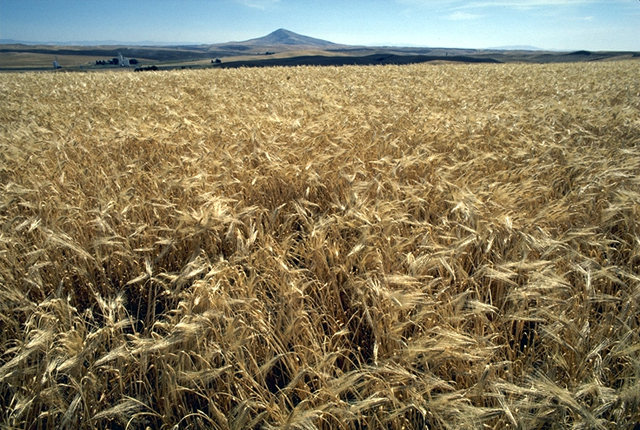 |
| A glowing, fluffy field of barley with some pretty, swoopy mountains in back. |
 |
| So these is barley plants then? |
Not to mention it's a diet drink, though I don't know where exactly, believed to help get rid of unwanted fat for you. It's also a laxative, but I don't know how popular it is for that feature. But, I hear (at least some of you) ask, warily eying the last sentence, what is mugicha?
To give you an actual definition, mugicha is a (caffeine-free) drink that's made with toasted barley and water (which means it's a tisane). In Japan, it's a thing to drink it in the summer, and ice is perfectly alright to add to it. Why drink it in summer? Its supposed to refresh those bogged down with the heat of summer temperatures. However, it's also a thing in Japan to drink mugicha warmed up in the winter. Sweetened or unsweetened are both acceptable as well, though I'm not sure if that goes for both hot and cold mugicha or just the cold or what.
 |
| Sure looks like pearl barley to me. |
He was right -- it tastes like Kashi, the puffed-gain cereal as located in the health food section. And, from my imperfect memory, I think it did sort of have a coffee type roasty-ness too. How do I know this? I made some (for the first time ever) this July. Here's a picture of it:

Want to make your own? There's lots of recipes out there, with lovely pictures on how to make it using pearl barley -- one roasts it via a skillet, no oil or anything, then simmers the result in water. La Fuji Mama's recipe has pictures showing the stages of toasty-ness that the barley goes through while it's in the skillet, as well as other helpful pictures (clicky). ( It was this site I used to make my aforementioned mugicha). La Fuji Mama also says there are several differences between un-hulled barley and pearl barley mugicha -- un-hulled barley mugicha isn't as sweet as the kind made with pearl barley and doesn't exactly have the same flavor.
But while you can make mugicha at home, there are commercial boxes of *huge* bags of it (each bag makes a pitcher), where all one does is put a bag into cold water (that's right -- cold water, a plus in hot weather), and wait for whatever length of time is stated in the box's directions. These bags use un-hulled roasted barley. If you don't want to spend any time at all making some, there's bottles of pre-brewed mugicha.
Now for a quick little health-scare PSA. There's acrylamide in mugicha (at least, the way the people studying mucha brewed it). This chemical may or may not cause cancer. Boo.
Oh, and one book said it's not barley that's used, it's wheat. And another said barley or rye. Type-o, or a deeper conspiracy? It might be a just type-o, as mugi can be used to mean, among other grains (rye, oats, barley), wheat -- though if you say it without explaining, people think you mean barley.
 |
| A pretty rendition of beef and barley soup. Just thought I'd put it here. Enjoy! |
References:
Sheesh, this is a long list! (Maybe I should start doing inline citations)
"Keith Michell's Practically Macrobiotic Cookbook"; Keith Michell; 2000
La Fuji Mama: Homemade Mugicha—Japanese Roasted Barley Tea
"Japanese Women Don't Get Old or Fat"; Naomi Moriyama, William Doyle; 2005
"Pretty Good Number One: An American Family Eats Tokyo"; Matthew Amster-Burton; 2013
"A Cook's Journey to Japan: Fish Tales and Rice Paddies 100 Homestyle Recipes from Japanese Kitchens" Sarah Feldner; 2012
"Kyotofu: Uniquely Delicious Japanese Desserts"; Nicole Bermensolo; 2015
"Lonely Planet Japan"; Lonely Planet, Chris Rowthorn, Andrew Bender, Laura Crawford, Trent Holden, Craig McLachlan, Rebecca Milner, Kate Morgan, Benedict Walker, Wendy Yanagihara; 2013
"The Macrobiotic Way: The Complete Macrobiotic Lifestyle Book"; Michio Kushi; 2004
"Five Hundred Fun Facts About Japan"; DIANE Publishing Company, Dorothy Perkins; 1994
"The Sober Kitchen: Recipes and Advice for a Lifetime of Sobriety"; Liz Scott; 2003
"Japanese Food and Cooking"; Stuart Griffin; 2011
"A Dictionary of Japanese Food: Ingredients & Culture"; Richard Hosking; 2014
"Handbook of Bioenergy Crops: A Complete Reference to Species, Development and Applications"; Nasir El Bassam; 2010
"The new beauty: an East-West guide to the natural beauty of body and soul"; 1996
"Berlitz: Japan Pocket Guide"; Berlitz; 2013
"Edible Medicinal And Non-Medicinal Plants: Volume 5, Fruits"; T. K. Lim; 2013
"Teach Yourself Japanese"; Prem Motwani, Noriko Nasukawa, Noriko Nasukawa; 1998
"The Complete Book of Japanese Cooking"; Elisabeth Lambert Ortiz, Mitsuko Endo; 2014
"Chemistry and Safety of Acrylamide in Food"; Mendel Friedman, Don Mottram (editors); 2005
Thursday, September 10, 2015
Sedōka: The 'Head-Repeat Poem'
 |
| Thanks to Nerd Paradise for the MS Paint tutorials. |
Lots of kinds of poetry we just don't
hear about these days, right? In general, like, everybody knows about iambic
pentameter (actually, I don't really), but what about the Pyrrhic meter or
the Homeric ode?
For that matter, everyone knows about haiku (俳句), and you might know about the tanka/waka (短歌/和歌), but there are possibly/probably other kinds of Japanese poetry (some of which are also called waka or 和歌) of which you've yet to hear.
Like the "head repeated poem"
or sedōka (旋頭歌). It's been out of
popular use, as I understand it, for nearly 1300 years. Barring any poetry
movements that I don't know about.
...If you're still reading this, then I guess I should actually get a move on and tell you about it. Here goes!
History Facts
Poets used the sedōka during the Nara
period, until -- during the same period -- the style "died on the vine of
abandonment and neglect", as it were (though I've also read people used it until the beginning of the Heian period). For whatever reason, people stopped
using it, even before fashion turned its back on the chōka. You can find some
sedōka in the Kokin Wakashū (early 900s AD, kanji thusly: 古今和歌集)
and in the Man'yōshū (759AD, spelled like this: 万葉集).
They're both poetry anthologies, in case you were wondering.
And now, the following fact, which I shall also place elsewhere. I could put it under Meter (that's below), but I put it here, as it fits too. Here it is: precision for the sedōka, and other kinds of waka, wasn't always strictly adhered to (I know, it's supposed to be Japan, right? Just goes to show, you can't trust stereotypes). People would play around with it.
And for that matter, a sedōka's theme
could be about anything.
The Meter
The sedōka is described as having two
tercets (had to look that one up), a tercet being three lines. In the sedōka's
case, the first line has 5 syllables, the middle one has 7 syllables, and the
last one also has 7 syllables, okay? That's 38 syllables. Okay. So, for some
unnecessary illustration, that's like:
知りたいよ shiritai yo I want to know, I tell you.
青い目が光る aoi me ga hikaru
blue eyes sparkle.
この命はね kono inochi wa ne
this life, you know?
星空 だ hoshizora da it's a/the starry sky
星の光が hoshi no
hikari ga the stars' light
海で踊 るよ
umi de odoru yo dance on
the ocean
Yup, I wrote that just for the sake of this blog post -- poetic, yeah? If not exact to the meter. Just remember, I am not fluent. And I don't know how much sense it makes in English, either.
After the first group of 18 syllables, you're supposed to pause before reciting the second group. The pause's supposed to create a sense of dialogue. Why would you want to do that? See below.
How Do You Use Sedōka?
When people still used the sedōka,
one thing I read they used it for was dialogues. The idea was for each chunk of
poetry to have a different look at the same thing (I read this after I wrote
the above poem)... or at least, that's what you can do. Were there other things? Dunno. Guess I'll have to read
the Man'yōshū and Kokin Wakashu to find out. The University of
Virginia Library has them both, among others, online for free.
Now, in order to add
cultural/psychological weight to this meter, I shall tell you about a
historical figure who wrote sedōka: Kakinomoto
Hitomaro. He's a poet who died in maybe 708 AD -- apparently he was and is
a rather famous poet.
 |
This
is a picture I found on (gasp! The shame) Wikipedia. It's supposed to be
Kakinomoto
and public domain.
|
References
Just so you can do your own fact checking and not have to rely on my ability to
process information (which admittedly tends to need debugging frequently)....
here's the places I used to write this post:
Subscribe to:
Posts (Atom)